Airbnb Cancellation Policy for Hosts: Flexible, Moderate, Firm, or Strict?
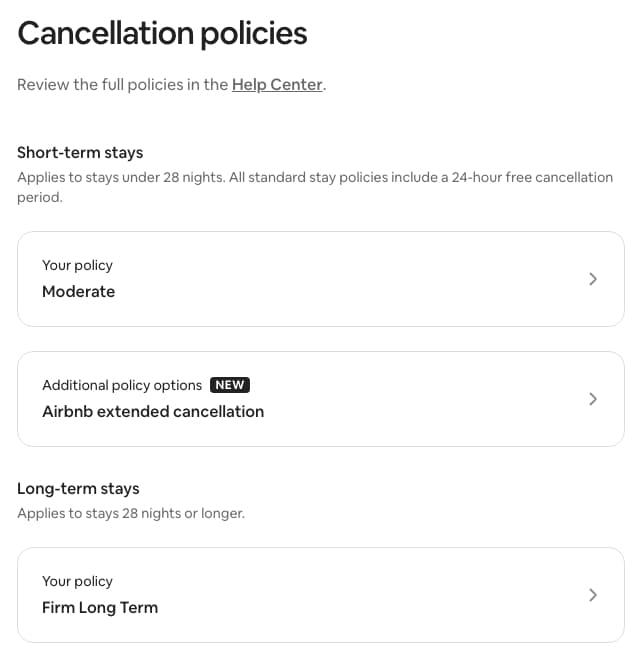
Airbnb gives hosts several cancellation policies for short-term stays — Flexible, Moderate, Limited, Firm, and Super Strict options — each determining how close to check-in a guest can cancel and still receive a refund. Long-term stays (28 nights or more) use separate Firm Long Term and Strict Long Term frameworks. The policy you choose directly affects your booking volume, your exposure to last-minute empty nights, and your Superhost eligibility. Flexible and Moderate policies convert browsers into bookings at higher rates because guests face less commitment risk. Strict policies protect revenue when a cancellation occurs but add friction at the point of booking. The right choice depends on your market, your listing type, and how much empty-night risk you can absorb.
Last updated:
Not sure which listing settings are limiting your bookings?
Get your listing diagnosisQuick Answer
For most Airbnb hosts, Moderate is the policy that balances booking volume against financial exposure. Guests can cancel up to five days before check-in for a full refund — enough flexibility for most travelers — while you keep your payout for cancellations inside that window. Strict makes sense for high-demand, hard-to-rebook listings. Flexible makes sense for new listings building review volume. Firm sits between Moderate and Strict and works well for listings where guests typically book 14 or more days out.
Airbnb Host Cancellation Policies
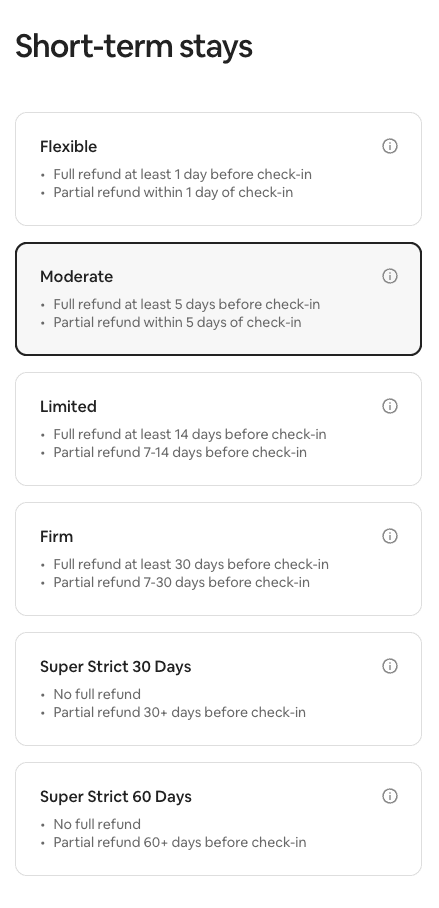
Airbnb offers several short-term stay cancellation policies — each defining the window before check-in during which a guest can cancel and receive a full or partial refund. Outside that window, you keep your payout. Here’s what each policy specifies, per Airbnb’s published cancellation terms.
Flexible
Highest booking conversionFull refund up to 24 hours before check-in. Guests who cancel within 24 hours of check-in, or after check-in has passed, receive no refund — you keep the payout for those nights.
Best for new listings, casual hosts, or listings that are easy to rebook within a day of cancellation.
Moderate
Most common for established listingsFull refund up to 5 days before check-in. Cancellations within 5 days receive no refund for the first night. Cancellations within 24 hours of check-in receive no refund at all.
Gives guests meaningful flexibility while protecting you from same-week cancellations — the ones hardest to fill on short notice.
Limited
Between Moderate and FirmFull refund up to 14 days before check-in. Partial refund for cancellations 7–14 days before check-in. No refund within 7 days of check-in.
A middle ground for markets where guests typically book 2–4 weeks out and you want more cancellation protection than Moderate without Firm's 30-day commitment window.
Firm
Best for advance-booking marketsFull refund up to 30 days before check-in. 50% refund for cancellations 7–30 days before check-in. No refund within 7 days of check-in.
Suited to listings in high-demand locations where guests book weeks or months out and you need certainty on those dates.
Strict
Strongest host financial protectionFull refund only within 48 hours of booking, and only if check-in is more than 14 days away. 50% refund for cancellations 7–14 days before check-in. No refund within 7 days of check-in.
Appropriate for listings that are genuinely hard to rebook on short notice — premium properties, remote locations, or peak-season dates.
Super Strict 30 Days & Super Strict 60 Days
Airbnb also offers Super Strict 30 Days and Super Strict 60 Days policies. These provide no full refund at any point — only a partial refund for cancellations 30 or 60 days before check-in respectively. They are not available to all hosts and typically require an invitation from Airbnb, usually extended to properties with unique characteristics where demand is consistently high enough to justify the stricter terms.
Additional Policy Options
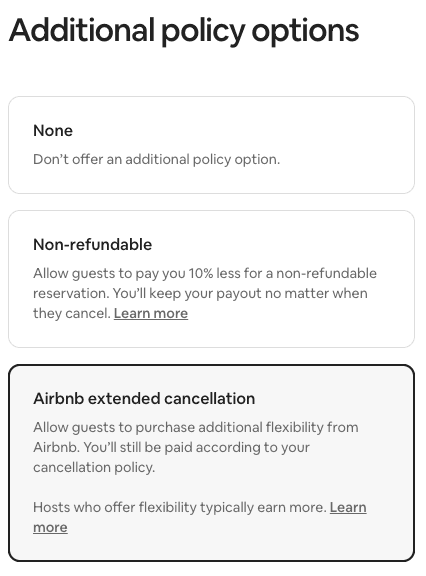
Alongside your standard policy, Airbnb lets you offer one additional option at booking — either Non-refundable or Airbnb extended cancellation. These are mutually exclusive: you pick one in your listing settings, and it applies to all guests. If a guest books under extended cancellation, they are not offered the non-refundable discount, and vice versa.
Non-refundable
Guests pay 10% less than your standard nightly rate in exchange for no refund at any time — per Airbnb’s published terms. Works best in price-sensitive markets where guests comparison-shop on rate. A secondary option that captures bookings you’d otherwise lose on price alone. Because guests who choose this rate get no refund under any circumstance, it is not compatible with Airbnb extended cancellation — guests can only use one or the other at booking.
Airbnb extended cancellation
NEWWhen you enable this option, guests can purchase additional cancellation coverage directly through Airbnb at checkout — separate from your listing price. If a guest cancels outside your normal refund window, Airbnb refunds them using the coverage they purchased. You are still paid in full according to your own cancellation policy, as if the cancellation never happened.
The practical effect: guests who would normally hesitate to book a Firm or Strict listing — because they’re uncertain about their travel dates — can now book with confidence that they have a safety net. You don’t give up any payout protection to offer it; Airbnb absorbs the cost of the guest’s refund.
This is most useful for hosts on Firm or Strict who want to attract flexibility-sensitive guests without actually softening their policy. For hosts already on Flexible or Moderate, the incremental impact is smaller since guests already have generous built-in terms. Enabling it costs you nothing, which is why Airbnb reports that hosts who offer it typically earn more — they capture bookings that would otherwise go to a listing with a softer policy.
Long-Term Stay Policies
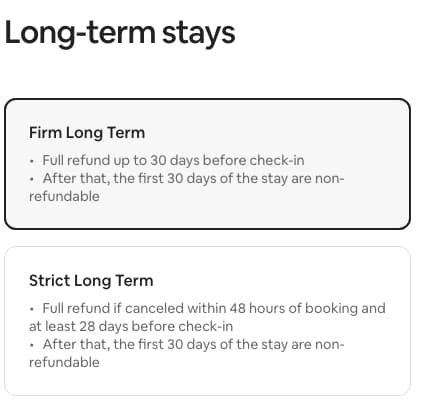
Long-term stays (28 nights or more) use separate cancellation policies set independently from your short-term policy. You choose between Firm Long Term and Strict Long Term in your listing settings.
Firm Long Term
Full refund up to 30 days before check-in. After that window, the first 30 days of the stay are non-refundable. Remaining nights beyond the first 30 that haven’t started are refunded.
Strict Long Term
Full refund only if the guest cancels within 48 hours of booking and at least 28 days before check-in. After that window, the first 30 days of the stay are non-refundable. Remaining nights beyond the first 30 are refunded.
How Your Cancellation Policy Affects Booking Volume
Guests weigh cancellation terms when comparing listings. A stricter policy raises the perceived commitment cost of booking — particularly for guests who are comparison-shopping, booking far in advance, or uncertain about their travel dates. Selah’s analysis across STR markets shows that listings on Strict cancellation policies typically see lower booking conversion rates than otherwise comparable listings on Moderate, holding price, photos, and amenities constant.
The effect is strongest among travelers planning far in advance — the same segment most likely to book Strict listings. These guests commit early because they want the date secured, but they also expect the ability to change plans without full penalty if circumstances shift. A Strict policy removes that flexibility without a meaningful price reduction, which pushes many of them to a competing listing with softer terms.
The calculation changes when your listing is difficult to replace in search results — a property in a location with limited supply, during a peak weekend, or with amenities that have no close local substitute. In those cases, guests accept stricter terms because their alternative is simply not booking. Your market context, not a universal rule, should drive the decision.
Booking conversion depends on more than policy — listing quality plays a larger role in most markets.
Airbnb Host Tips →Host-Initiated vs. Guest-Initiated Cancellations
Airbnb tracks two entirely separate cancellation rates — yours as a host, and the guest’s. These have different consequences and operate independently of each other.
Guest cancellations
When a guest cancels, Airbnb applies your cancellation policy and issues the appropriate refund automatically. You receive any non-refundable payout per your policy terms. Guest cancellations have no effect on your host cancellation rate, your Superhost eligibility, or your search ranking.
Host cancellations
When you cancel a confirmed reservation, Airbnb issues a full refund to the guest regardless of your policy. Airbnb applies financial penalties for host-initiated cancellations and may block your calendar for the cancelled dates so no other guest can book them. Host cancellations count against your Superhost eligibility — Airbnb requires fewer than 1% to maintain the status.
Extenuating circumstances
Airbnb maintains a separate policy for cancellations caused by events outside your control — natural disasters, severe illness, and similar situations. If Airbnb approves an extenuating circumstances request, the cancellation does not count against your host rate and no financial penalty is applied. Approval requires documentation and is not automatic.
The Practical Rule
Never cancel a confirmed reservation unless the alternative is genuinely worse — a safety situation, a property emergency, or an Airbnb-recognized extenuating circumstance. The penalties for host cancellations are designed to make them costly. If a guest is difficult to work with before they arrive, contacting Airbnb to mediate is almost always preferable to cancelling the booking yourself.
Cancellation Policy and Superhost Status
Superhost status requires a host-initiated cancellation rate below 1% over the prior 12 months — one cancellation in 100 reservations is the hard limit. Your cancellation policy choice does not directly affect this rate. Guest cancellations don’t count regardless of which policy you use. What matters is whether you, as the host, cancel confirmed bookings.
The indirect connection runs through host behavior under financial pressure. If a guest books on Flexible terms and the dates later become more valuable — a local event drives demand, or a longer-stay inquiry comes in — some hosts are tempted to cancel the lower-rate booking. That temptation exists regardless of policy, but a Firm or Strict policy that locks in better terms from the start reduces the gap between the booked rate and the optimal rate, making cancellation less financially motivating.
Superhost requires maintaining four performance thresholds — cancellation rate is one of them.
Superhost Criteria Guide →Choosing the Right Cancellation Policy for Your Listing
There is no single right policy. The decision comes down to three variables: how far in advance guests in your market typically book, how difficult your listing is to rebook on short notice, and where you are in your listing’s lifecycle.
Start with Flexible or Moderate
New listing (under 10 reviews)Booking volume matters more than margin protection at this stage. A new listing needs completed stays to build review history — the reviews that unlock better search visibility and future conversion. Strict policies slow that accumulation. Once you have 15 or more reviews and can rely on social proof to close bookings, reassess.
Use Moderate as your baseline
Established listing in a competitive marketModerate provides enough flexibility for most travelers to commit while protecting you from same-week cancellations, which are the hardest to fill on short notice. Selah's analysis across markets shows Moderate consistently performs as the best balance point for listings in competitive urban and suburban markets.
Consider Firm or Strict
Premium or hard-to-replace listingIf your listing has unique amenities, a location with limited supply, or a design profile that has no close substitute in search results, guests will accept stricter terms. The premium listing market rewards quality with reduced booking friction — guests who specifically want your property are willing to commit more firmly.
One consideration that cuts across all three scenarios: rebook risk varies by season. Some hosts run Moderate year-round and use pricing to capture peak-demand value. Others tighten to Firm during peak months when a last-minute cancellation is genuinely hard to fill and the dates can’t be recovered on short notice. Either approach can work — the consistency of a single policy tends to win on annual average, since guests learn your terms and book accordingly.
Choosing Your Additional Policy Option
Once you’ve set your primary policy, pick one of the three additional options — or leave it at None. The right choice depends on where your biggest booking friction comes from: price or cancellation flexibility.
Choose Non-refundable
Price-sensitive marketIf guests in your market comparison-shop heavily on nightly rate, the non-refundable discount gives you a way to capture price-driven bookings without permanently lowering your standard rate. It works best when your listing already has solid reviews and photos — where the 10% discount is the last remaining friction point, not a deeper hesitation about quality.
Choose Airbnb extended cancellation
On Firm or StrictIf you're on Firm or Strict, you're likely losing some bookings to competitors with softer policies — guests who want your property but won't commit without a safety net. Extended cancellation solves that without touching your payout protection. Airbnb covers the refund cost, not you, so there's no financial downside to enabling it. This is the default recommendation for any host on Firm or Strict.
None or Non-refundable
On Flexible or ModerateIf your primary policy is already Flexible or Moderate, guests have generous built-in cancellation terms and extended cancellation adds little incremental value. Leave it at None unless you want to test the non-refundable discount to capture rate-sensitive bookings. Extended cancellation is designed to offset friction created by strict policies — on a lenient policy, it's largely redundant.
Instant Book interacts directly with your cancellation policy — enabling it changes who books and on what terms.
Airbnb Instant Book Guide →About This Guide
This guide is written by Selah Collective, a short-term rental consultancy that audits and improves Airbnb listings for hosts. Policy terms are drawn from Airbnb’s published cancellation policy documentation. Performance patterns are based on Selah’s analysis of STR listing data across markets. Selah is not affiliated with Airbnb.
Not Sure What’s Limiting Your Bookings?
The Selah Score™ audit reviews your listing across five performance areas — including booking settings, pricing alignment, and guest experience gaps — and identifies what’s most likely holding back your revenue.
Frequently Asked Questions
Which Airbnb cancellation policy gets the most bookings?
Flexible and Moderate policies typically generate more inquiries and bookings than Strict — Selah's analysis of STR listings shows hosts on these policies receive meaningfully more conversions than comparable listings on Strict at similar price points. The trade-off is higher exposure to last-minute cancellations. For most new listings building review volume, Moderate is the practical starting point: enough guest flexibility to convert browsers, enough host protection to avoid same-week empty nights.
Can I change my Airbnb cancellation policy after a guest books?
No. Once a guest books under a specific cancellation policy, that policy applies to their reservation regardless of any changes you make to your listing after the booking. You can update your cancellation policy for future bookings at any time from your listing settings, but the update will not apply retroactively to confirmed reservations.
What happens when a guest cancels my Airbnb booking?
When a guest cancels, Airbnb applies your chosen policy to determine their refund and processes it automatically — you don't need to approve or handle the refund. You receive the payout for any non-refundable nights per your policy terms. Guest-initiated cancellations do not count against your host cancellation rate and have no effect on your Superhost eligibility or search ranking.
Does a strict cancellation policy hurt my Airbnb search ranking?
Airbnb's algorithm does not directly penalize a Strict cancellation policy. The indirect effect is real, though: Strict policies typically reduce booking conversion, which means fewer completed bookings — and booking velocity is one of the signals Airbnb uses to rank listings in search. A listing on Strict that books less frequently than comparable Flexible listings in the same market will tend to see lower visibility as a secondary consequence.
What is Airbnb's cancellation policy for long-term stays?
Long-term stays (28 nights or more) use separate long-term policies — Firm Long Term or Strict Long Term — set independently from your short-term policy. Firm Long Term gives guests a full refund up to 30 days before check-in; after that, the first 30 days of the stay are non-refundable. Strict Long Term offers a full refund only if the guest cancels within 48 hours of booking and at least 28 days before check-in; after that, the first 30 days are also non-refundable. In both cases, any remaining nights beyond the first 30 that haven't started are refunded.
How does my cancellation policy affect Superhost status?
Your policy choice does not directly affect Superhost status — your host-initiated cancellation rate does. Airbnb requires fewer than 1 host-initiated cancellation per 100 reservations to maintain Superhost. Guest cancellations never count against you. The indirect link: hosts who cancel confirmed bookings because the terms feel unfavorable take the hit on their rate. Choosing a policy that protects your revenue from the start reduces the financial temptation to cancel.
What is the non-refundable option on Airbnb and is it worth using?
Airbnb's non-refundable option lets guests pay 10% less in exchange for no refund at any time — per Airbnb's published pricing terms. You can offer it alongside your standard policy; guests choose at booking. It works well in price-sensitive markets where guests comparison-shop primarily on rate. In markets where last-minute cancellations are common, the 10% discount may not offset the certainty it provides.
Ready to see where your listing stands?
Get a complete audit of your listing — booking settings, photos, amenities, pricing, and more.